Propolis

bees, honey and other sticky subjects

Thursday, November 22, 2007

Hampshire's beekeepers celebrate 125 years at Wooton St Lawrence

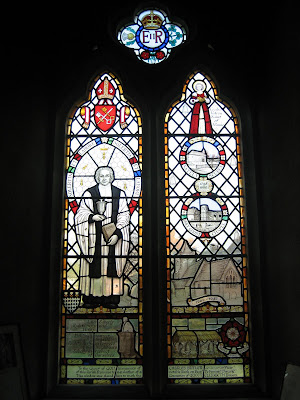
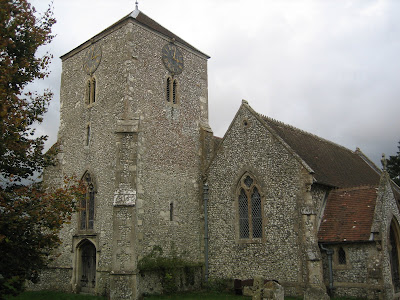
This may seem like any other English parish church, but it has a particular association for beekeepers and on 10 November 2007, Hampshire Beekeepers Association (HBA) celebrated its 125th birthday there for a very special reason. It is the church of the Rev Charles Butler, sometimes called the Father of English Beekeeping.

Born in 1560, Butler was vicar at Wooton St Lawrence parish church in Hampshire, UK from 1600 to 1648. His book, The Feminine Monarchie was a tour de force and amongst other things popularised the notion that the largest bee in a hive was a female and therefore a queen and that bees made wax from scales on their underbellies.

Butler's achievements are now recognised with a wonderfully detailed stain-glass window installed in 1953.

And, as the Chairman of HBA said at the meal afterwards, what can we do that will last 125 years to emulate our predecessors who established the HBA in 1882.
 
Posted by Picasa


Labels: ,

Monday, October 29, 2007

Brood exhibition

There's a must-see exhibition for anyone interested in beekeeping at Winchester's Great Hall in Hampshire, UK.

Bill Woodrow has Brood — Sculpture from the Beekeeper Series 1996-2007 on show there until 10 December 2007.

The exhibition features honey and wax and the gold glistens. The larvae high in the walls were especially commissioned for the Great Hall.

My photographs of a few of the exhibits do not of course do it justice — so if you can, do go to see it.

I should say something about the Winchester Great Hall. It dates from the thirteenth century and is described as the first and best of its type. On the wall (visible in the pictures) is a huge symbol of mediaeval mythology: The Round Table of King Arthur.


Hive 2005


Rockswarm 2001 


Close-up of Rockswarm 2001 
Posted by Picasa


Beekeeper and Golden Ring 1998 


Part of Shadow of the Beekeeper 1998 
Posted by Picasa


Can you see the pupae? 
Posted by Picasa

Labels: ,

Sunday, September 16, 2007

The gold rush is gathered

The 2007 harvest is almost in -- just a bit more heather honey to come and a lot of ivy nectar being gathered which I will certainly not extract as it has the most disgusting taste I have ever encountered from a honey.

From an initial six colonies I have extracted something between 400 and 500 lbs (approx 200 kg) of honey. The bees have grown to eight colonies having already united some colonies and given away a couple of others during the course of the year. I'm pleased with the harvest since it has been such a poor summer after a terrific spring.

I now want to reduce further to six colonies, expecting that I may lose one or two over winter from the various ailments abounding. (I am about to treat for varroa -- a little late some would say, but this time of year works for me in this area.)

BTW, for those new to Propolis, attracted by the bell jar picture links, you might be interested to see other images including lots of close-ups filed under the my pictures keyword.

Labels: ,

Friday, September 14, 2007

Bell jar bees -- the slide show

Lots of nice comments coming in about the bees in the bell jar (via howithappened, boingboing and elsewhere) -- but regular readers might have missed the slideshow of progress over the past couple of months. I see how I can try to help the bees improve the design -- and just this morning was given another bell jar. So roll on next season!

Labels: , ,

Wednesday, September 12, 2007

Bell jar bees complete the task

The bell jar bees have finished the job -- with one fatality left entombed in gold (second photo). (For progress at each stage, click the bell jar bees keyword.)


Posted by Picasa


Posted by Picasa

Labels: , ,

Thursday, August 16, 2007

Blog idle

From a completely different Irish context: "I haven't gone away, you know." But I have been blog-idle. So here's a little update before I depart for another couple of weeks.

The bell-jar bees are progressing slowly. But it's not as if there are not enough workers! I'm surprised they can breathe in such a crowded house. Nectar seems to be scarce, but it is dribbling in and being stashed in the cells. Hardly any is yet capped. I had planned to remove the jar before departing, but despite the travel-staining of the walk-about bees I think I should let them finish the job.

 
Posted by Picasa

Labels: , ,

Wednesday, July 18, 2007

Bell Jar Bees Day 12

Even though the season is nearly over, the bees continue to work in the bell jar and are now starting to store honey. If you look very carefully in the second picture, you'll see some very peculiar bee legs.


Posted by Picasa

Labels: , ,

Friday, July 13, 2007

Bell Jar Bees Day Seven

Steady rather than spectacular progress probably because the weather has not been the best for nectar collection.

 
Posted by Picasa

Labels: , ,

Wednesday, July 11, 2007

Bell jar bees: day five

The infrastructure cells are now being constructed to contain the honey. But it is a race against time: I expect the nectar flow to slow down soon and the bees may even be thinking about swarming because this is the last empty part of the hive and they must be feeling a little cramped.

 
Posted by Picasa

Labels: , ,

Monday, July 09, 2007

Busy as bees in a bell jar

It's day three in the bell jar and the bees are showing considerably more interest in their new home extension.

The decoration hasn't really begun -- this is more like the undercoat being applied. They walk around, chewing a bit here and there and generally casing the joint. They still have some comb building to complete in the super below, so no clusters of wax builders have yet appeared in the bell jar. (They will cluster to raise the temperature to enable the wax to be excreted and built.)

Incidentally, the jar is kept wrapped in an old t-shirt and there is a hole in the top of the jar to prevent the build-up of condensation.

 
Posted by Picasa

Labels: , ,

Saturday, July 07, 2007

Will they or won't they?

It's been a miserable early summer in southern England and with only about ten days of the nectar flow to go, I've at last been able to put the bell jar in place.

I've stuck small strips of foundation to the inside of the jar and the idea is that the bees will join the dots and make a pretty picture. So far, so good. Within a few hours, they seem to have accepted the jar as a potential nest extension and haven't been put off by the strange new environment. But will the good weather hold and will they take up the challenge?


Posted by Picasa

Labels: , ,

Thursday, June 14, 2007

Synchronised fanning

My bees were taking time out today to practise for that famous sport of lining up your stripes with the grain on the wood of the hive:

 
Posted by Picasa

Labels: , ,

Monday, June 11, 2007

Captions, please!

 
Posted by Picasa


well well....the cups are again half empty...somebody from the government or the tax department must have been here.....
from Slavik

What are you doing there?
Oh, everbody have to be somewhere!
courtesy of Bluebottle in The Goons

Labels:

Riders of the swarm

After rather too long a blogging break, I'm back with a story about a cycle in Oxfordshire today.

As a friend and I pedalled around a corner a rather familiar sound hit my ears, followed by a few objects bouncing off my face. We'd run into a swarm of bees about to form in a hedge. This is the first time I've ever accidentally run into a swarm in the countryside. I did see one fly over my office window once, but I've certainly never ridden into one. As all beekeepers will know, no, we didn't get stung.

So, if any beekeeper in Lyford, South Oxfordshire is missing some bees, s/he could try the hedge on right-angle corner in the village.


And in a village a little later on the trip, a church with an hexagonal tower. Perhaps the swarm was headed there.

 
Posted by Picasa

Labels: , ,

Friday, May 04, 2007

Just hanging out

A textbook swarm -- hanging up about 20 meters from their original home, geting read to move to a final destination.
 
Posted by Picasa

Labels: ,

Wednesday, May 02, 2007

The Queen and her retinue

 
Posted by Picasa


I clip my queen's wings so that they don't get far if/when they swarm. Swarms in chimneys and elsewhere can be quite anti-social, so I try to make sure that my swarms don't upset the neighbours. Some people object to clipping -- but I see it as the lesser of two evils.

Obviously the clipping cannot do the Queens much harm -- if done delicately. This happens to be the only Queen that has stayed with me over two winters. On all other occasions, my Queens have left me withing one year. Older beekeepers talk about three, four and five year old queens, but they seem to be becoming more short-lived. Some suspect that, for whatever reason, mating is not what it used to be! Some think that drones are either fewer or less fertile.

The constantly changing workers around the Queen are sensing her Queen pheromone with their antennae and spreading it around the colony so that everyone knows that mummy is at home and keeping well. It's thought that if her pheromnones fail, or if the colony is too congested, her scent does not impregnate the colony and the workers then start making a new queen.

Labels: ,

In, out, shake it all about, oooohhhh ....

That mating nucleus in my garden has been teasing me for three days. It's just below my office window and six times in the past three days it has attempted to swarm. No, let me correct that -- five times it attempted to swarm, the sixth time it was successful.

The fifth attempt ended up in my next door neighbour's garden. But they returned, presumably because the queen decided not to go with them.

The sixth, successful, attempt ended up three gardens away. I have caught it in a skep and wonder if they will stay there until dusk.

My questions: why did it take six attempts to swarm? Is this a regular occurrence? Do beekeepers tend to miss this because they are not so close to their hives during the working day? Perhaps they only tried three times and two of the attempts were actually the returning queenless swarm? And did I miss any attempts? And, and, and ...

My twenty-year-old cat, however, seems to have a sixth sense. She knows about 15-30 minutes in advance of when they will swarm and beats a retreat indoors from the garden. Perhaps, she smells the swarming pheromones, assuming there are such things.

The fifth, queenless swarm that returned from its birch tree hang-out:
 
Posted by Picasa

Labels: , ,

Monday, April 30, 2007

My apiaries

I have four apiaries (just one or two colonies in each), so I thought you'd like to see where they are. They are in little gaps in the woodland in the right of centre of both pictures.


Posted by Picasa

Labels: ,