Propolis

bees, honey and other sticky subjects

Thursday, March 13, 2008

Another bee movie: The Secret Life of Bees

The best seller The Secret Life of Bees featuring two beekeeping sisters and focusing on racism and civil rights is being made into a film.

Labels:

Thursday, November 08, 2007

All he is saying is ...

A lawsuit is flying because Jerry Seinfeld's recently released Bee Movie uses the catchphrase "Give Bees a Chance,". Richie Gerber, known to Howard Stern fans as Cousin Richie, owns an organic skin and hair-care company called BeeCeuticals Organics that claims the phrase as its own. He claims that DreamWorks and Paramount, after initially exploring opportunities to work with Gerber, went ahead and used the phrase to market the movie as if it were their own.

Howard Stern's cousin is crying foul about Jerry Seinfeld's recently released Bee Movie, saying the flick uses his company's catchphrase, "Give Bees a Chance," without permission.

Richie Gerber, known to Stern fans as Cousin Richie, owns an organic skin and hair-care company called BeeCeuticals Organics, and claims in a lawsuit filed late last week in Fort Lauderdale, Florida, that DreamWorks and Paramount, after initially exploring opportunities to work with Gerber, went ahead and used the phrase to market the movie as if it were their own.

"We were talking about co-sponsoring an event, a 'Bee In,' for National Pollinator Week in June," Gerber told MTV News, "and even on that press release, we used that slogan."

"We are not killer bees," Gerber said. "All we want is for them to acknowledge that it's our intellectual property and license it from us. We're worker bees, we'll work with you."

Labels:

Monday, October 29, 2007

Brood exhibition

There's a must-see exhibition for anyone interested in beekeeping at Winchester's Great Hall in Hampshire, UK.

Bill Woodrow has Brood — Sculpture from the Beekeeper Series 1996-2007 on show there until 10 December 2007.

The exhibition features honey and wax and the gold glistens. The larvae high in the walls were especially commissioned for the Great Hall.

My photographs of a few of the exhibits do not of course do it justice — so if you can, do go to see it.

I should say something about the Winchester Great Hall. It dates from the thirteenth century and is described as the first and best of its type. On the wall (visible in the pictures) is a huge symbol of mediaeval mythology: The Round Table of King Arthur.


Hive 2005


Rockswarm 2001 


Close-up of Rockswarm 2001 
Posted by Picasa


Beekeeper and Golden Ring 1998 


Part of Shadow of the Beekeeper 1998 
Posted by Picasa


Can you see the pupae? 
Posted by Picasa

Labels: ,

Monday, October 15, 2007

That Bee Movie

The Seinfield/Spielberg collaboration, Bee Movie, is due for release in the USA on 2 November (it happened to be the subject of one of the first Propolis blog postings).

So, beekeepers, brace yourselves! Here's why Jerry Seinfield wanted to make the film:

“I just thought bees were funny. They live in a small company. They have a product. They have offices. They have bosses. They have employees. They have schedules. So it seemed like a little corporation hanging from a tree, and I thought that was a good situation for a movie - you could tell a good story about what goes on in that company.”
Forgive my purist leanings, but can anyone tell me who the bee boss/es happen to be? I'm damned if I can get my head around that one.

Labels:

Monday, September 17, 2007

Queen bee passes away

I was saddened to hear that Dr Eva Crane died earlier this month, aged 95. Her obituary is in The Independent, The Times, The New York Times amongst others. She lived in the neighbouring county to me, but I regret being too late to beekeeping never to have heard her speak.

Anyone interested in bees and honey should look at her remarkable publishing record:
Crane produced more than 180 scientific papers, articles and books on bees, honey and beekeeping; her books include Honey: a Comprehensive Survey (1975), A Book of Honey (1980), The Archaeology of Beekeeping (1983), Bees and Beekeeping: Science, Practice and World Resources(1990) , The World History of Beekeeping and Honey Hunting (1999) and, a book about her travels, Making a Bee-Line (2003).

Labels: ,

Thursday, June 28, 2007

Sex on stamps

Four new stamps featuring pollination are being issued by the US Post Office tomorrow. Bees, birds, butterflies and bats are all featured pollinating four wildflowers. One look at the bat tells me that Disney must have been involved somewhere in the process. The bees? Maybe they are Apis stylizedus. The stamps were designed by artist Steve Buchanan of Winsted, Connecticut.

 
Posted by Picasa

Labels:

Monday, April 30, 2007

CCD's silver lining

Since CCD hit the news, Toni (a regular reader) is noticing how many people have become more honeybee-aware. Her friends keep pointing out interesting bee news. Like the friend who sent her this link about how honeybees have helped to develop a model for allocating web hosting resources http://www.isye.gatech.edu/eemag/pdfs/20041Spring.pdf.

Labels: , ,

Tuesday, April 24, 2007

CCD finger-pointing at imidacloprid

The search for the cause of CCD continues and there is some finger-pointing at the neonicotinoid group of chemicals, particularly imidacloprid, a seed treatment commonly used in Europe and the United States, as a possible cause, says the New York Times and others. Imidacloprid is a systemic treatment that finds its way in minute traces into pollen, and, I think, nectar.

In the late 1990s, French beekeepers blamed Gaucho, a brand name for imidacloprid, for disorienting and indirectly causing bee colony deaths. The chemical was banned for use with sunflowers and later maize. Apparently, Bayer's internal research says the chemical is harmless to bees, but independent French researchers disagree.

Labels: , , ,

Thursday, April 19, 2007

Bees and mobile phone research uncovered and er ...

At last, someone has uncovered the research that led to the press frenzy on mobile phones and bees. An enterprising soul on Bee_L has managed to get links to two papers on the web (in German and in English). He is distinctly underwhelmed.

The studies (a pilot study and a follow-up) were actually about electromagnetic fields, especially DECT phones, on the learning ability of bees. It said nothing about CCD, the methodology seems dodgy and and and ... but you can read them for yourself.

Or there is a very good report (in English)in Spiegel Online.

Labels: , , ,

Monday, April 16, 2007

How the media works Part One

The British press has grabbed on to the speculation that mobile phone radiation might be the cause of CCD by affecting bees' navigation. Tabloids and broadheets have joined in: The Independent, The Daily Telegraph, The Daily Mail and The Sun.

The Sun of course overlooks the speculation part: “Mobile phones have wiped out millions of bees, scientists warned last night.”

And all because a German researcher is reported to have found that when he placed mobile phones (I don't know if it's one or more) beside a hive the bees didn't return to the hive.

About a month ago, I heard from an American suggesting HAARP (High Frequency Active Auroral Research Program) as the cause.

UPDATE: I cannot trace the research paper that sparked this story -- and other people have been looking without success too. I think the original journalist needs to give their source!

Further update: journalist rumbled.

Labels: , , ,

Tuesday, March 13, 2007

Bees, red herrings and scapegoats on the Eiffel Tower

Kerry tells me about a stitch-up on the Eiffel Tower. It's another book that features -- or maybe doesn't feature -- a bee.

From the blurb, it already seems clear that the bee is a red herring and a scapegoat (picture that!) and that it didn't cause the death of our short-lived heroine on the second floor of the Eiffel Tower. And, any way, if you've ever been up the Tower, you'll wonder why on earth a bee would fly so high in the first place.

The book is: Murder on the Eiffel Tower by Claude Izner from Gallic Books.

Labels:

Sunday, March 11, 2007

Four Walls


A Greek island mystery that features bee-keeping has been shortlisted for a British foreign literature award. The book, Four Walls, was written by Vangelis Hatziyannidis and translated from Greek by Anne-Marie Stanton-Ife. Envelope day is 1st May.

Shame on the cover designer who doesn't know the difference between a bumblebee and a honeybee.

Meanwhile the synopsis from Amazon:
Following the death of his beekeeper father, P Rodakis lives a solitary life in the old family house on a Greek island. He takes in a young fugitive woman and her daughter. Thanks to his father's secret recipe, they produce delicious honey that becomes highly sought after. P Rodakis is captured and imprisoned by a jealous monk who wants the power of the honey for himself. Rosa goes in search of her real father and incest and imprisonment become the themes explored in this powerful novel.

Labels:

Sunday, March 04, 2007

Hiveside broadcasting

Promotion of beekeeping by British beekeepers has encouraged a BBC Radio 4 programme Broadcasting House to adopt an urban hive and following its progress through the season.

Labels: ,

Sunday, January 21, 2007

Out of the blue

Beekeeping crops up in the most surprising places:

It's a slight metaphor in Syriana, the geopolitical thriller starring George Clooney, when wold be suicide bombers are shown to be beekeeping (carelessly). No bees starred in the film, but -- you guessed it -- a sting did.

And in Norman Mailer's new “nonsensical”, The Castle in the Forest, there are 60-odd pages (with an emphasis on odd) on beekeeping describing what happened when part of a colony mysteriously died and the rest had to be gassed in order to save the hive. Possibly a metaphor for the gas chambers, even Mailer hints that the reader might want to skip the pages. Sounds absurdist.

Labels: ,

Thursday, December 07, 2006

Kellogg's bumble

If you ever thought that Kellogg's Cornflakes were an odd sort of food and that their corn looked rather peculiar, you will not be surprised at their latest (British) TV advert for Honeyed Cornflakes. It's a very smart advert with animated bees flying around -- the only problem is they are bumble bees.

So I'm not quite sure how they gathered bumble bee honey to put on those corn flakes.

Labels:

Saturday, November 18, 2006

Bee Movie peek

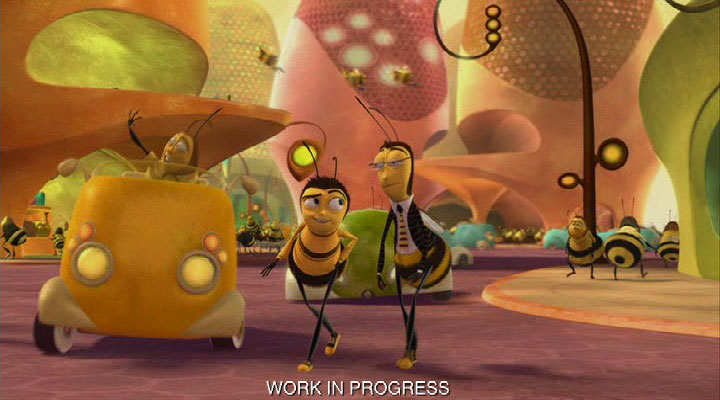
Here's a two-minute clip from Jerry Seinfield's Bee Movies to be released in twelve months' time.

Labels:

Tuesday, October 24, 2006

Previewing Jerry Seinfeld's Bee Movie


One of the very first posts on this blog was about Jerry Seinfeld's planned bee movie. Well, it's due to be distributed by Dreamworks on 2 November ... 2007.

Here's a synopsis:
Bee Movie is the comedic tale of Barry B. Benson, a graduate bee fresh out of college, who is disillusioned with the prospect of having only one career choice -- honey. On a chance opportunity to go outside the hive, Barry's life is saved by a woman, Vanessa, a florist in New York City. As their relationship blossoms, Barry's eyes are opened to the world of humans and he soon discovers that people partake in the mass consumption of honey. Armed with this information, Barry realizes his true calling in life and decides to sue the human race for stealing the bees' honey. As a result, the bee and human communities get involved in ways they never had before, each one of them pointing a finger at the other. Barry gets caught up in the middle and finds himself with some very unusual problems to solve.

Labels:

Thursday, October 19, 2006

Fiji stamp of approval

Despite cyclones and other naural disasters, one of the fastest growing industries in Fiji is beekeeping. Hives are expected to increase from 7000 to 8000 this year and honey production from 200 to 250 tonnes.

And they are celebrating beekeeping in stamps.

Labels: , ,

Sunday, October 08, 2006

Crop art

An excellent honeybee maize maze in Minnesota.

Labels:

Wednesday, October 04, 2006

We're all trendy now!

Alison Benjamin, the deputy editor of Society Guardian, took up beekeeping in North London this year and her story has made it onto TV, a blog ... and of course The Guardian newspaper.

Labels: