Propolis
bees, honey and other sticky subjects
Friday, January 25, 2008
New Scientist this week features swarming and compares it to a human brain activity. (You'll need a subscription for the link.)
Tuesday, December 04, 2007
Friday, June 15, 2007
Vintage film
How would you deal with 700 prime swarms a year?
Here's a brilliant video from a heather skep apiary in Lower Saxony, Germany. It's a huge skep apiary and the date of the filming is unclear but may be 1979.
I've never seen their technique for catching swarms -- essentially a huge sock attached to the skep entrance. The most interesting part starts at about 3 mins 30 sec; the total video is just over 12 minutes long. Lots to marvel at, including the woody English tones of the narrator.
Via Bee_L.
Here's a brilliant video from a heather skep apiary in Lower Saxony, Germany. It's a huge skep apiary and the date of the filming is unclear but may be 1979.
I've never seen their technique for catching swarms -- essentially a huge sock attached to the skep entrance. The most interesting part starts at about 3 mins 30 sec; the total video is just over 12 minutes long. Lots to marvel at, including the woody English tones of the narrator.
Via Bee_L.
Labels: swarming
Tuesday, June 12, 2007
Piping the queen out
As most beekeepers know, the queen doesn't actually control her colony, though she appears to react to signals from her workers. Now Andrew Pierce and Stanley Schneider of the University of North Carolina have documented what actually happens -- or at least a later stage in the swarming process:
workers use the vibration signal to prepare the queen for swarming by making intrusions into her “court” and vibrating her hundreds of times an hour. She responds by changing her behavior -- reducing her food intake, slowing egg laying and becoming more active. At this point, the workers begin to send a second signal that researchers call “worker piping” at a fevered pitch. Piping, which consists of bees making contact and vibrating their wing muscles rapidly, appears to be a general instruction to fly.Just what we always expected: big sisters always get their way.
Monday, June 11, 2007
Riders of the swarm
After rather too long a blogging break, I'm back with a story about a cycle in Oxfordshire today.
As a friend and I pedalled around a corner a rather familiar sound hit my ears, followed by a few objects bouncing off my face. We'd run into a swarm of bees about to form in a hedge. This is the first time I've ever accidentally run into a swarm in the countryside. I did see one fly over my office window once, but I've certainly never ridden into one. As all beekeepers will know, no, we didn't get stung.
So, if any beekeeper in Lyford, South Oxfordshire is missing some bees, s/he could try the hedge on right-angle corner in the village.
And in a village a little later on the trip, a church with an hexagonal tower. Perhaps the swarm was headed there.
As a friend and I pedalled around a corner a rather familiar sound hit my ears, followed by a few objects bouncing off my face. We'd run into a swarm of bees about to form in a hedge. This is the first time I've ever accidentally run into a swarm in the countryside. I did see one fly over my office window once, but I've certainly never ridden into one. As all beekeepers will know, no, we didn't get stung.
So, if any beekeeper in Lyford, South Oxfordshire is missing some bees, s/he could try the hedge on right-angle corner in the village.
And in a village a little later on the trip, a church with an hexagonal tower. Perhaps the swarm was headed there.
Labels: my pictures, quirky, swarming
Friday, May 04, 2007
Just hanging out
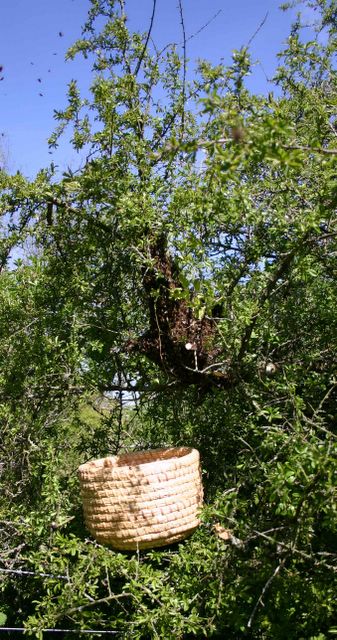
A textbook swarm -- hanging up about 20 meters from their original home, geting read to move to a final destination.
Labels: my pictures, swarming
Wednesday, May 02, 2007
In, out, shake it all about, oooohhhh ....
That mating nucleus in my garden has been teasing me for three days. It's just below my office window and six times in the past three days it has attempted to swarm. No, let me correct that -- five times it attempted to swarm, the sixth time it was successful.
The fifth attempt ended up in my next door neighbour's garden. But they returned, presumably because the queen decided not to go with them.
The sixth, successful, attempt ended up three gardens away. I have caught it in a skep and wonder if they will stay there until dusk.
My questions: why did it take six attempts to swarm? Is this a regular occurrence? Do beekeepers tend to miss this because they are not so close to their hives during the working day? Perhaps they only tried three times and two of the attempts were actually the returning queenless swarm? And did I miss any attempts? And, and, and ...
My twenty-year-old cat, however, seems to have a sixth sense. She knows about 15-30 minutes in advance of when they will swarm and beats a retreat indoors from the garden. Perhaps, she smells the swarming pheromones, assuming there are such things.
The fifth, queenless swarm that returned from its birch tree hang-out:
The fifth attempt ended up in my next door neighbour's garden. But they returned, presumably because the queen decided not to go with them.
The sixth, successful, attempt ended up three gardens away. I have caught it in a skep and wonder if they will stay there until dusk.
My questions: why did it take six attempts to swarm? Is this a regular occurrence? Do beekeepers tend to miss this because they are not so close to their hives during the working day? Perhaps they only tried three times and two of the attempts were actually the returning queenless swarm? And did I miss any attempts? And, and, and ...
My twenty-year-old cat, however, seems to have a sixth sense. She knows about 15-30 minutes in advance of when they will swarm and beats a retreat indoors from the garden. Perhaps, she smells the swarming pheromones, assuming there are such things.
The fifth, queenless swarm that returned from its birch tree hang-out:
Labels: my beekeeping, my pictures, swarming
Monday, April 30, 2007
Calling back the troops
Either a virgin queen left on a mating flight today or she left with a swarm.
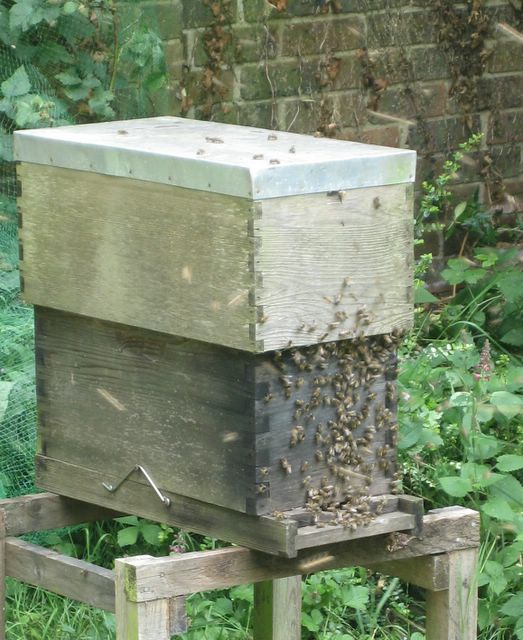
Here's the hub-bub at the entrance to the nucleus hive. And below are workers calling in the troops in the aftermath sending their nasinov marker pheromones into the air.
I had a similar incident last year, but this season's is two months earlier. We've had an extraordinary spring with average April temperatures 3C above the monthly average.
Here's the hub-bub at the entrance to the nucleus hive. And below are workers calling in the troops in the aftermath sending their nasinov marker pheromones into the air.
I had a similar incident last year, but this season's is two months earlier. We've had an extraordinary spring with average April temperatures 3C above the monthly average.
Labels: my beekeeping, my pictures, swarming
Thursday, April 19, 2007
Why I like bees
Today my bees foiled me (again). Two colonies are super-strong for so early in the year. Last weekend, one colony was putting eggs in queen cells. None of the cells yet contained royal jelly, so there was always the possibility that the queen cells might be aborted before they really started.
Since then it has been excellent nectar-gathering weather, so I expected that they might want to swarm before the coming weekend. The books say that a queen cell is sealed eight days after the egg is laid. So today is the fifth, or possibly eighth day after the eggs were laid. And, you guessed it, when I looked, some cells were sealed. Worker eggs were still evident and the bees were calm, so the queen was almost certainly still at home. So, time for a split.
Well, I couldn't find the queen despite three comb scans, so I used the tried-and-tested method of ensuring that the queen was in one brood box, adding another and separating them by a queen excluder. I intended tomorrow to separate the boxes.
One hour later, a swarm appeared about fifty metres from the hive. How could a clipped queen fly so far?
Update: I should have known! After a few hours the swarm went home. Obviously they realised that mummy hadn't come with them. It took a long time for them to find out though!
Since then it has been excellent nectar-gathering weather, so I expected that they might want to swarm before the coming weekend. The books say that a queen cell is sealed eight days after the egg is laid. So today is the fifth, or possibly eighth day after the eggs were laid. And, you guessed it, when I looked, some cells were sealed. Worker eggs were still evident and the bees were calm, so the queen was almost certainly still at home. So, time for a split.
Well, I couldn't find the queen despite three comb scans, so I used the tried-and-tested method of ensuring that the queen was in one brood box, adding another and separating them by a queen excluder. I intended tomorrow to separate the boxes.
One hour later, a swarm appeared about fifty metres from the hive. How could a clipped queen fly so far?
Update: I should have known! After a few hours the swarm went home. Obviously they realised that mummy hadn't come with them. It took a long time for them to find out though!
Labels: my beekeeping, swarming
Thursday, April 05, 2007
Home my bees!
Last autumn I prepared seven colonies for winter, wanting only four colonies in spring and expecting some to die during the winter because of the various and mysterious bee ailments about.
And guess what? Yes, seven healthy colonies came through, two in such exceptional condition that I expect them to try to swarm in April. I'm now looking for new beekeepers in search of colonies.
Labels: my beekeeping, swarming
Tuesday, June 27, 2006
Mating swarm or an aborted swarm?
At lunchtime today I was treated to a beautiful site. I have a little mating nucleus in the garden and as I was making lunch, I noticed a lot of activity at the entrance to the hive. I sat outside to watch it and as I did so the air filled with bees.

Getting ready for some action.

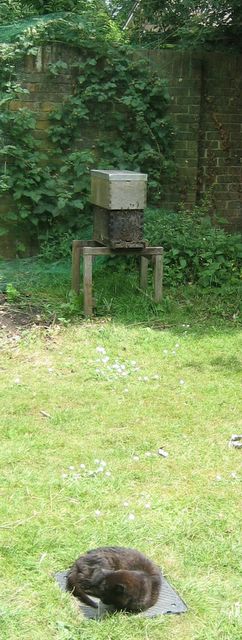
One elderly deaf cat oblivious to the excitement around her as the air filled with bees.
It looked just like a swarm developing, but they were taking a long time to settle -- first around a birch tree in the next door garden and then around a yew tree in my garden where they even formed a cluster. After about 20 minutes they all seemed to return to the hive.

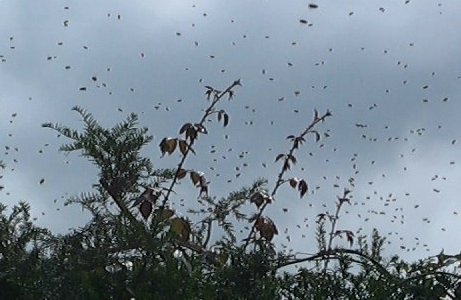
Air thick with swarming bees.
It was a treat -- but I'm not sure if it was an aborted swarm headed by a virgin who somehow got lost, or whether this was a rare sighting of a mating swarm. The little cluster on the yew tree suggested the former, but I really don't know. It's the first time in eleven years' beekeeping that I've been able to watch the whole process.

Calling everyone back to the hive -- bums up waving their nasinov glands in the air.
But that wasn't the end of it. A blackbird flew into the top of the yew, but departed rapidly when she saw who else was there. I think she has a nest in the tree. And then I saw a tiny blackbird perched and shivering on the little compost bucket outside the kitchen. I think it had been frightened out of the yew by the bees. I think the little chap/ess eventually found his or her mother before my elderly cat found it. Truly a story of the birds and the bees.

The little evicted blackbird waiting for mummy.
UPDATE 28 June: It was a swarm. And they've gone. At 9.45am this morning, they started swarming again, but this time they left the garden and went several gardens away where I can't reach them. So it must be a caste swarm headed up by a virgin queen. I doubt if they will survive the season.
But that will teach me for saying just a couple of days ago that there were no swarms in this area this year because a certain beekeeper had given up!

Getting ready for some action.


One elderly deaf cat oblivious to the excitement around her as the air filled with bees.

It looked just like a swarm developing, but they were taking a long time to settle -- first around a birch tree in the next door garden and then around a yew tree in my garden where they even formed a cluster. After about 20 minutes they all seemed to return to the hive.

Air thick with swarming bees.

It was a treat -- but I'm not sure if it was an aborted swarm headed by a virgin who somehow got lost, or whether this was a rare sighting of a mating swarm. The little cluster on the yew tree suggested the former, but I really don't know. It's the first time in eleven years' beekeeping that I've been able to watch the whole process.

Calling everyone back to the hive -- bums up waving their nasinov glands in the air.

But that wasn't the end of it. A blackbird flew into the top of the yew, but departed rapidly when she saw who else was there. I think she has a nest in the tree. And then I saw a tiny blackbird perched and shivering on the little compost bucket outside the kitchen. I think it had been frightened out of the yew by the bees. I think the little chap/ess eventually found his or her mother before my elderly cat found it. Truly a story of the birds and the bees.

The little evicted blackbird waiting for mummy.

UPDATE 28 June: It was a swarm. And they've gone. At 9.45am this morning, they started swarming again, but this time they left the garden and went several gardens away where I can't reach them. So it must be a caste swarm headed up by a virgin queen. I doubt if they will survive the season.
But that will teach me for saying just a couple of days ago that there were no swarms in this area this year because a certain beekeeper had given up!
Labels: my beekeeping, my pictures, swarming
Monday, June 26, 2006
Swarming stopped at source
I've been rather disappointed not to have had a single swarm call this season. I've been wondering why. An encounter in the village explained all -- a local beekeeper gave up her bees last year. I'd suspected her as the source of swarms and it seems I was right.
Although beekeeping seems to be ion the increase, I don't think there is another beekeeper within three miles of this village. When I started beekeeping there were at least five others.
Labels: swarming
Saturday, April 01, 2006
Artificial swarm tip
How often have you split a hive to try to create an artificial swarm only to find that you cannot find the queen? There's a good 50% chance of leaving the brood-and-queen-cells split with the old queen -- 100% chance if Murphy has a hand in it.
Bee Craft, the monthly magazine of the British Beekeepers' Association has a great tip this month for such situations:
Move the brood combs to a new brood box leaving all the bees in the original brood box. Then put a queen excluder on top of the old brood box and place the new brood box at the top of the reassembled hive. Then one day later, create a new hive with the new brood box to the side of the old one and carry on with your artificial swarm as normal.
What happens is: the queen (and all the bees) is inevitably left in the old brood box, but when the hive is reassembled the nurse bees make their way to the brood in the new brood box at the top of the hive. The queen can't get through the excluder and so stays in the old brood box.
Nice one! As long as the bees don't attempt to swarm in the 24 hours that the hive remains as one.
Bee Craft, the monthly magazine of the British Beekeepers' Association has a great tip this month for such situations:
Move the brood combs to a new brood box leaving all the bees in the original brood box. Then put a queen excluder on top of the old brood box and place the new brood box at the top of the reassembled hive. Then one day later, create a new hive with the new brood box to the side of the old one and carry on with your artificial swarm as normal.
What happens is: the queen (and all the bees) is inevitably left in the old brood box, but when the hive is reassembled the nurse bees make their way to the brood in the new brood box at the top of the hive. The queen can't get through the excluder and so stays in the old brood box.
Nice one! As long as the bees don't attempt to swarm in the 24 hours that the hive remains as one.
Labels: swarming
Saturday, November 26, 2005
Iceberg sings like a swarm
The speeded-up sound of an iceberg sounds like a swarm of bees or a orchestra tuning up say scientists.
“Once the iceberg stuck fast on the seabed it was like a rock in a river,” said scientist Vera Schlindwein. “The water pushes through its crevasses and tunnels at high pressure and the iceberg starts singing. The tune even goes up and down, just like a real song.”I wonder what it says if you play it backwards.
Labels: swarming
Friday, July 15, 2005
The year of the swarm
Two swarms in my village in two days (and neither of them mine!) I've had more swarm calls this year than at any time since varroa hit in the mid 1990s. I'm not sure if that's good or bad news. Are there more feral colonies about? I hope not. They'll be harbouring varroa -- and maybe foulbrood. To have two swarms so late in the season is also a bit of a puzzle.
Tonight I picked up the largest swarm I've ever taken. It was so big I thought it might have been an absconding colony, albeit not quite full-size. An elderly woman who claims to like wildlife had sprayed it last night -- to little effect. I gave her a good telling off!
I gave the rescued swarm to a new beekeeper who intends to let them start building comb in my temporary beer-box hive (Grolsch, if you must know) and then after a few days transfer them to her new hive. That way any disease they may be carrying in honey in their stomachs will be used up in wax-building and can then be disposed of. That's the theory anyway.
Tonight I picked up the largest swarm I've ever taken. It was so big I thought it might have been an absconding colony, albeit not quite full-size. An elderly woman who claims to like wildlife had sprayed it last night -- to little effect. I gave her a good telling off!
I gave the rescued swarm to a new beekeeper who intends to let them start building comb in my temporary beer-box hive (Grolsch, if you must know) and then after a few days transfer them to her new hive. That way any disease they may be carrying in honey in their stomachs will be used up in wax-building and can then be disposed of. That's the theory anyway.
Labels: honeybee health, swarming, varroa
Friday, June 24, 2005
Swarmy nostalgia
It's been one of the best(?) swarming seasons for years here in south central England. And there are a few theories floating around.
This is my twelfth season of beekeeping and I well remember the first weekend of May in my second year of beekeeping in 1995. There were over 100 swarm calls to the local authority -- all on one weekend! It had been a long and nectar-rich spring and the weather had turned really good at the start of May, so the bees had fun. At that stage varroa hadn't yet taken a significant toll (perhaps none).
But by the end of that season, varroa wreaked havoc and took out a high percentage of managed colonies and nearly all the feral ones -- in this area at least. Since then swarms have been few and far between. I was pleased if I received one call a year!
This year is different -- I've had four calls over the past few weeks. Swarming usually occurs here in May, but June has seen most swarms this year.
And the theory goes like this: Last year during the May swarming season, the weather took a decidedly nasty turn. As a result many of the new queens may not have mated properly. Mine certainly didn't -- and some tried to swarm again last June to replace poorly fertilised queens. Other queens held out for the season, but beekeepers are now paying the price. A number of people around here are reporting (genuinely) queenless colonies. And queens which may have lasted more than a year are rare.
This is my twelfth season of beekeeping and I well remember the first weekend of May in my second year of beekeeping in 1995. There were over 100 swarm calls to the local authority -- all on one weekend! It had been a long and nectar-rich spring and the weather had turned really good at the start of May, so the bees had fun. At that stage varroa hadn't yet taken a significant toll (perhaps none).
But by the end of that season, varroa wreaked havoc and took out a high percentage of managed colonies and nearly all the feral ones -- in this area at least. Since then swarms have been few and far between. I was pleased if I received one call a year!
This year is different -- I've had four calls over the past few weeks. Swarming usually occurs here in May, but June has seen most swarms this year.
And the theory goes like this: Last year during the May swarming season, the weather took a decidedly nasty turn. As a result many of the new queens may not have mated properly. Mine certainly didn't -- and some tried to swarm again last June to replace poorly fertilised queens. Other queens held out for the season, but beekeepers are now paying the price. A number of people around here are reporting (genuinely) queenless colonies. And queens which may have lasted more than a year are rare.
Sunday, May 15, 2005
The swarm has landed
Armed with a saw and skep, the swarm was brought down to my height, collected and hived this morning.

ready skep?

bee reskepticle
How to make a skep -- looks easy doesn't it? It ain't! An overview of skeps -- history, skep making and skep beekeeping.

ready skep?


bee reskepticle

How to make a skep -- looks easy doesn't it? It ain't! An overview of skeps -- history, skep making and skep beekeeping.
Labels: swarming
Friday, April 08, 2005
Swarm catching is easy after this
Go catch some bees -- a new game. You have to catch bees in a bubble. And if you are as bad at this as me, you'll be mortified when you see other people's scores. Thanks to Rufus for pointing this one out. Gee, thanks Rufus!
Labels: swarming
Thursday, February 03, 2005
Swarm sense
Just a few bees may be able to direct a swarm according to a researcher at Oxford University, UK. Iain Couzin developed an algorithm that shows how simple animals can use simple rules to make complex group decisions. Only a few animals need to know what they should be doing, and, as the group gets larger, the proportion of clued-up animals actually falls.
The algorithm gives its virtual animals several rules of thumb. One is that they try to avoid becoming cut off from the crowd. ... Another rule is that group members should avoid getting so close that they crash into one another.
In addition to these opposing forces, the virtual animals are given a power of persuasion that depends on their desire to lead the group in a specific direction. Completely naive animals, with no idea of where to go, have zero power.
The simulations show that even when naive and informed individuals cannot recognize one another, the novices spontaneously respond to decisions by the experts, because they follow their tendency to stick with the group.
Labels: swarming
Tuesday, September 07, 2004
Exterminator shows his skills in swarm collection
“An exterminator” was called to remove a swarm of bees from a jeep at the top of the Grand Canyon. Maybe they should have called a beekeeper -- just look at these pictures of his efforts. (To non-beekeepers: I don't think any beekeeper would use a plastic sheet to remove bees and certainly not to get in a tangle like this.)
Labels: swarming